
Healthcare Dashboard
Hospitals using fragmented reporting systems wait 48+ hours for actionable data, costing a 300-bed facility an estimated $1.2M annually in preventable readmissions and inefficient bed management. Our enterprise healthcare Power BI consulting unifies clinical, financial, and operational data into a single, HIPAA-compliant, real-time command center that delivers clinical analytics in minutes.
Scaling from single clinics to multi-site networks, our Power BI deployment connects natively to Epic and Cerner via FHIR connectors, surfacing critical KPIs like ICU occupancy, mortality trends, and discharge velocity. Leadership gets the precise intelligence to eliminate reporting delays, drive clinical efficiency gains, and accelerate measurable hospital ROI.



What is a Healthcare Power BI Dashboard?
A healthcare power bi dashboard is a HIPAA-compliant clinical analytics platform that connects patient, financial, and operational data from disparate hospital systems into a single, governed view, enabling real-time tracking of value-based care metrics, insurance denials, and clinical performance from one Single Source of Truth (SSOT).
Our healthcare power bi implementation uses a secure azure data factory and power bi setup to transform fragmented EHR and billing records into structured, role-appropriate reports. It also establishes a live data bridge between power bi and your existing Epic or Cerner EHR architecture via certified FHIR R4-compliant connectors, normalized to a consistent healthcare semantic data layer without disrupting clinical workflows or requiring EHR re-configuration. The same methodology extends to Meditech environments and legacy HL7 v2 feeds, ensuring no system is left outside the governed analytics environment. Care teams get click-to-expand dashboards with the clinical governance intelligence needed for faster, safer operational decisions, without waiting on IT or submitting reporting tickets.
- DASHBOARD
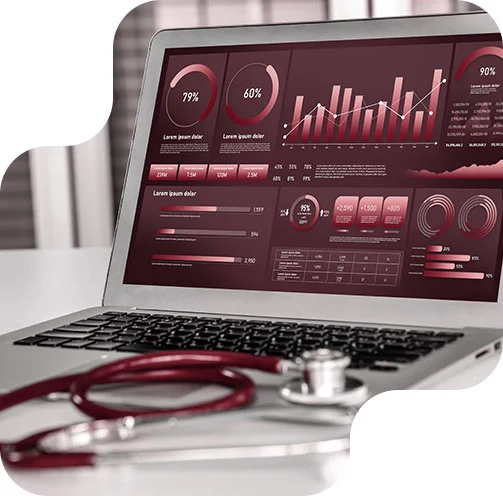
Live Healthcare Analytics Dashboard
Our live, interactive dashboard provides immediate access to clinical and operational metrics through self-service filters, eliminating the need for IT tickets or static reports. By connecting directly to your hospital data via automated ETL pipelines, we replace the typical 48-hour reporting lag with up-to-the-minute real-time clinical intelligence, a shift that, across our client deployments, has reduced average time-to-decision for capacity management from two days to under four hours.
KPIs & Metrics Tracked
Effective healthcare performance management demands more than surface-level reporting. Every KPI embedded in this dashboard is mapped to a specific business question and designed to drive meaningful action at every organizational level. The following metrics form the analytical backbone of a healthcare power bi dashboard.
- Total Patients: Shows the live number of active, admitted, and discharged patients to help leaders plan staffing and space needs in real time.
- Mortality Rate: Tracks patient survival rates against National Quality Benchmarks to ensure continuous clinical quality standards are maintained.
- Average Length of Stay : Tracks inpatient days to improve bed turnover and reduce operational costs, directly tied to revenue cycle performance.
- Patients by Gender / Age Group / Department : Provides demographic and operational breakdowns for trend identification, service planning, and mandatory reporting compliance.
- ICU Occupancy Rate: Monitors intensive care bed utilization so staff can reallocate resources before units reach critical capacity.
- Readmission Rate: Measures 30-day return rates, helping identify discharge planning gaps and avoid CMS financial penalties.
- Average Days to Discharge: Highlights delays between clinical readiness and actual patient exit, surfacing bottlenecks in the discharge workflow.
- Patient Discharges: Monitors discharge velocity to protect admission capacity and prevent downstream care access bottlenecks.
Key Features of the Healthcare Power BI Dashboard
Our healthcare power bi dashboard is designed and deployed with enterprise-grade architecture, combining clinical data depth with operational intelligence capabilities that scale across single facilities and multi-site health networks. Every feature below reflects a deliberate design decision rooted in real-world healthcare bi implementation experience.

Real-Time Data Integration
Multi-Source Data Connectivity
Advanced Clinical Data Visualization
Predictive Analytics Models
Automated Reporting & Alerts
Role-Based Access Control (RBAC)
Mobile Dashboard Access
Flexible Deployment
Target Audience
Our healthcare power bi dashboard is purpose-built for high-stakes leadership teams who require a single, verified source of truth to drive clinical quality and protect hospital margins. Implementation investment also varies by audience need, ranging from single-facility deployments integrating 1-2 EHR systems, to enterprise-wide rollouts across multi-site health networks with full data warehouse design.
- CEOs & Managing Directors
- CTOs & CIOs
- Chief Medical Officers & Clinical Directors
- Operations Managers
- Finance & Revenue Cycle Teams
- Data Analytics Leaders
- Quality Assurance & Compliance Teams
Turn Clinical Data Into Strategic Decisions
Your hospital generates thousands of data points every hour. We transform them into real-time intelligence that drives faster, better decisions, and measurable efficiency gains your leadership team can report on immediately. Experience exactly how our healthcare power bi dashboard works with your specific data environment.

Why Healthcare Organizations Need Power BI Dashboards
Healthcare leaders are increasingly expected to justify clinical decisions, optimize resource utilization, and demonstrate measurable outcomes, all while managing growing patient volumes and escalating regulatory complexity. A healthcare power bi dashboard is no longer a reporting upgrade; it is a core operational infrastructure component for any data-driven health system operating in today’s environment.
- Consolidate Fragmented Data: Unify hospital systems into a single governed analytics environment.
- Monitor Vital Metrics: Track ICU occupancy, readmissions, and throughput in real time.
- Identify Early Trends: Spot performance issues across departments before escalation.
- Accelerate Clinical Governance: Automate reporting with audit-ready dashboards on live data.
- Improve Forecasting: Predictive models reduced unplanned ICU overflow by 22%.
- Enable Strategic Planning: Drive decisions with verified, longitudinal data.
- Enhance Regulatory Readiness: Simplify compliance with automated KPIs and audit trails.
Key Benefits of the Healthcare Power BI Dashboard
Organizations that implement an enterprise healthcare power bi dashboard consistently report measurable improvements across clinical quality and operational performance. These outcomes reflect the direct analytical leverage that structured, real-time business intelligence delivers in complex health system environments.
Reduced Average Length of Stay
Real-time discharge readiness visibility allows care teams to address bottlenecks proactively, client deployments have recorded average LOS reductions of 1.2–1.8 days within the first 90 days of implementation.
Minimized ICU Overcrowding
Predictive capacity alerts and occupancy trend monitoring enable proactive staffing decisions before a capacity crisis develops.
Lower Readmission Rates
High-risk patient identification and care coordination gap analysis at the point of discharge reduces the likelihood of a 30-day return.

Faster Leadership Decision-Making:
Verified clinical and operational KPIs reach stakeholders instantly, eliminating the 48-hour manual reporting lag and enabling real-time facility management.
Elimination of Data Silos
Unify EHR, billing, and scheduling data into a Secure Healthcare Data Warehouse, establishing a single source of truth across the entire organization.

Superior Clinical Quality Governance
Standardized mortality tracking and automated benchmarking against national reference datasets strengthen quality assurance programs.

Max ROI on IT Infrastructure
Rather than replacing current systems, we build the Power BI analytics layer directly on top of your existing EHR, HIS, and billing infrastructure.
Start With a Free Analytics Assessment
Success Stories From Our Clients

A leading US-based financial services firm faced increasing challenges…
Result:
28% pipeline success rate
22% Faster Alert Resolution Time

A well-known French perfume retailer wanted to increase profits during the busiest shopping months….
Result:

A leading U.S. financial institution struggled with slow and inconsistent loan approvals…
Result:
40% Decrease in Approval Time
25% Accuracy in Credit Score
- WHY CHOOSE
Why Choose Us as Your Healthcare Analytics Partner?
We do not deliver generic dashboards. We architect healthcare analytics ecosystems, combining deep Microsoft Power BI technical expertise with genuine domain knowledge across hospital operations, clinical quality programs, and enterprise BI implementation. Every engagement is governed by our documented HIPAA Implementation Framework, a structured methodology covering data classification, access control design, and audit trail configuration from day one.

Healthcare Domain Expertise
Over 10 years of enterprise implementation experience across acute care and pharmaceutical environments, with a portfolio spanning 40+ health system deployments across the US and EU.

Certified Power BI Architects
Microsoft PL-300 and DP-600 certified engineers with deep specialization in healthcare data modeling and custom DAX clinical measure development.

End-to-End Capability
Services spanning data engineering, ETL pipeline development, and secure HL7/FHIR data warehouse design, delivered by a single, accountable team.

HIPAA-Compliant Architecture
Security and data governance embedded at every layer, including Row-Level Security (RLS), column-level encryption, and Purview-integrated audit logging, to ensure full regulatory compliance.

Tailored Clinical Workflows
Custom dashboards built specifically for your departmental reporting requirements, never generic templates repurposed from other industries.

Ongoing Strategic Partnership
Engagements include dashboard maintenance, data model optimization, and structured user adoption programs for continuous operational enhancement.


